Friday, October 21, 2011

Queen Elizabeth II in Australia Looked Down Upon

Pardon the pun, but I just had to post this photo of Queen Elizabeth II on her 11 day state visit to Australia as part of her Diamond Jubilee year being introduced last night to English born Australian basketball star Elizabeth Cambage who happens to be 6 foot 8 inches to the diminutive Queen Elizabeth's 4 foot 10! The meeting was at a Parliamentary reception at Parliament in Canberra.  It's a great photo from the International Press Association.


Cheers!

The Art Of Art Nouveau in Drawer Pulls, Jewelry, Biscuit Jar, Teacup

Design periods are always fun. They have defining flavor and illustrate a period in history. One of my favorite periods is the Art Nouveau period which literally translates as New Art in French. The artistic style was a reaction to the sytlized Academic art which grew out of the idealized art of Europe. It was considered a young, new and organic style, taking its themes and treatment from natural themes. Art Nouveau pieces were often naturalistic themes with flowing design. Nature became the reference book and a languid, flowing beauty was the result. The design period is roughly from the late 1880s to 1910 when the angular art deco period came into vogue.

Great Art Nouveau designs were showcased at Liberty's in London and the Jugenstil in Germany. Basically, all items, whether clothing, paintings, jewelry or even cigarette ads...think Mucha's famous ad for Job cigarette papers...was influenced by art nouveau. Below is an art nouveau design rhinestone lavaliere or pendant with genuine coral and freshwater pearl.


Art Nouveau design was applied to all items in the home. Here is a biscuit jar...cookie jar to Yanks...made by George Jones & Sons, England between 1891-1893. The water lily is so evocative of the art nouveau period. Note the stylized rose motif which is a nod to the Scottish branch of Art Nouveau ala Charles Rennie MacIntosh.


The next example is an unmarked cup and saucer that screams art nouveau. Look especially at the handle area. I love it! 


And art nouveau design didn't stop with these type of materials. Below are examples of 2 sets of 2 art nouveau design drawer pulls with fabulous organic designs made of tin with cast iron handles from England dating to the 1890s. Both these sets of drawer pulls or hardware were originally gilded with varying remnants still remaining. They must have been spectacular! They're pretty neat right now!


Pretty cool! And what a great addition to items today these would be! All of the items shown are out of current stock at Time Was Antiques. For more info on any of them, click on the photos.

So...I hope you can see why Art Nouveau design is such a favorite of mine. Look for examples yourself. They are getting harder to find, but you never know! Art nouveau had a renaissance in the 1960s with the drug culture when Mucha was rediscovered and that form used for psychedelic rock band posters which was pretty fun.

Have a great weekend, and have a cup of tea with a friend. 
 

Thursday, October 20, 2011

English Toasting Forks For Vintage Thingie Thursday,QEII in Australia

Hi and happy Thursday! I am joining Vintage Thingie Thursday at Colororadolady today with a fun part of vintage English thingies...a toasting fork!


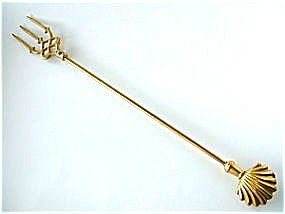
 Toasting forks came into being because of the need to be able to toast things over open fires...before toasters as we know them as counter top appliances were invented. The bread slice, muffin or crumpet was pierced by the fork end and held to the fire to toast on one side then turned and toasted on the other. Toasting forks were still used in England into the 1940-1950s when most fireplaces were replaced with 3-4 bar electric heaters. But folks swore...at least our families did...that a crumpet toasted by the fire had a far superior taste than those toasted in the new fangled toasters or under the grill of the kitchen cooker. The toasted goodie was then buttered and eaten with the rest of your tea.

The toasting forks were usually made of brass or with brass fittings and a cast iron shaft. The finials cover the gamut. The funny looking one is called the Lincoln Imp for a local Lincolnshire mythical creature. The stag was an early Victorian piece and exceptionally well made. Fun, huh???

I still find them periodically when we are in England on a buying trip. They don't last in the shop though. These photos are from my archives of past items at Time Was Antiques


Queen Elizabeth II arrived in Australia for an 11 day state visit, having sufficiently recovered from a cold a week ago...a major accomplishment when you are 85! The visit is an early part of her celebration of her Diamond Jubilee year...1952-2012 


Here is a link to the BBC coverage of the arrival with a great video:
BBC Queen Elizabeth in Australia

Monday, October 17, 2011

Tuesday Cuppa Tea, German Teacup, Tea Quote Art Of Tea And Friendship

Welcome to Tuesday Cuppa Tea with Time Was Antiques meme. I am joining the other Tuesday tea themed blog parties seen below.


I love this fancy German cup and saucer from the 1930-1940s from an unknown German maker with the pattern name Debra and a pattern of forget me nots. The handle is especially pretty and looks like the shape of half a butterfly. I love it! The foot is so pretty as well. It is perfect for a cup of tea while remembering summer...it seems to be well and truly gone here on the Olympic Peninsula of Washington state. The Olympics range in Olympic National Park has snow already. We are taking a fall trip up to Hurricane Ridge in the part tomorrow for a year's farewell to the park before it is snowed in.  

For more info on the German teacup at Time Was Antiques, click on the photos.


A tea quote from Sandy Lynam Clough's neat book The Art Of Tea And Firendship

There is no trouble so great or grave,
that cannot be much diminished
by a nice cup of tea.
Bernard-Paul Heroux
page 47

I am participating with these fine blog parties, and have a Mr Linky below...I'd love to have you join me, and love to hear from you.

Kathy~  http://blissfulrhythm.blogspot.com/
Victoria - A Return to Loveliness
Martha~  http://www.marthasfavorites.com/ 
Teacup Tuesday
 
Terri~  http://artfulaffirmations.blogspot.com/ 
Teacup Tuesday
Wanda Lee~  http://silkenpurse.blogspot.com/ 
Teapot and Tea Things Tuesday
 
Pam~  http://breathoffreshair-paperbutterfly.blogspot.com/ 
Teapot and Tea Things Tuesday
 
Wanda Lee~  http://theplumedpen.blogspot.com/ 
Tea For Two and Wednesday Tea For Me and Thee
Trisha~  http://sweetology101.blogspot.com/ 
Tea Party Tuesday
Lady Katherine~  http://ladykatherineteaparlor.blogspot.com/ 
Teatime Tuesday
Teatime Tuesday 


Sunday, October 16, 2011

What Is That Thing Monday - Antique Cheese Dish Or Wedge

As an antique dealer with 30+ years in the business, and a specialty in English items I get asked often the question "What is this?" So I decided to do a weekly feature on that. I did a feature on antique carpet balls recently, and another on antique clay pipe bowls. Today it is cheese dishes or cheese wedges. Have you every seen these wedge shaped dishes and wondered what they were used for?


A cheese wedgw with a scene from Charles Dicken's Oliver Twist "Oliver Asks For More" made in the 1930s by Lancaster & Sandland
 

A Goss, England Victorian miniature cheese dish in a style called Crested China dating to the 1880s, a souvenir of Blackpool, England
 
 A heart shaped cheese dish by Royal Winton, England in the hand decorated and rarely seen Georgia pattern made between 1942-1951

I guess I call this "Cheese dishes I have known and loved" as all are either currently at Time Was Antiques or have been sold through that site. 

Cheese has always been an important part of the English diet. Knowing that fact helps one to understand one of the reasons the Brits have resisted entry into the European Common Market. As part of the EU regulatory statutes, unless you receive protection for the use of a certain name/recipe of a foodstuff, you have to change the product to conform to EU guidelines to be easily sold throught the common market. So...without protection being granted, Double Gloucester cheddar would have to be made differently to/and be sold as EU cheddar, no more Wensleydale (poor Wallace & Gromit) and the other varying and not to say peculiar types of cheese, would have to be dumbed down. And an Englishman's castle has always had cheese dish...albeit it's probably nowadays from Tuppweware, or some such from ASDA, the English version of Walmart. A cheese course is traditionally part of an English meal and is often a part of "pudding" which means dessert, or in addition to it.

England is known for it's cheese. I recently reported on the Cheshire Cheese Rolling Festival. Where else but England???

This is an antique Carlton Ware, England cheese dish I added to the shop recently:


The numbers at the bottom of the mark are called the British Registry Date marks and can give a pretty good idea of the date the design was registered. This is number 21352 which dates by the registry system to 1893. Cool! For more info on the Carlton Ware Cheese Wedge at Time Was Antiques, click on the photos.

Cheese dishes were not all wedges, and here are 2 examples of other shapes from my archives


So the next time you see an odd wedge shaped china dish with a plate...you'll know what it is! Click on the photos for more info if. If they are ins stock, you will go to the listing at Time Was Antiques.

And I'll see you soon with another What Is That That Thing? post.
Cheers! Have a cuppa with a friend!

Friday, October 14, 2011

Vist in The Buckingham Palace Kitchens With Oz Chef Bill Granger

The Monarchy website on Facebook has just posted this interesting video of a visit to Buckingham Palace kitchens by Australian chef Bill Granger in advance of a State dinner following an announcement of the Queen Elizabeth !!'s forthcoming visit to Australia. 

Interesting to hear the ages of the Buck House chefs and how long some have been working there. The items mentioned are Pavlovas and Lamingtons. 

In 1935, the chef of the Hotel Esplanade in Perth, Western Australia, Herbert Sachse, created the pavlova to celebrate the visit of the great Russian ballerina, Anna Pavlova. Whilst it has been suggested this dessert was created in New Zealand, it has become recognized as a popular Australian dish. Recipe to follow.


Lamingtons are small squares of plain cake, dipped in melted chocolate and sugar and coated in desiccated coconut. Said to have been named after Baron Lamington, a popular governor of Queensland from 1896 to 1901.


TRADITIONAL PAVLOVA
4-6 egg whites
pinch salt
8oz castor sugar/sugar (equal parts)
1 teaspoon white vinegar
1/2 teaspoon vanilla essence
2 level teaspoons cornflour

(Please note the following equivalents:
castor sugar or fine/super fine sugar
corn flour or cornstarch)

Preheat oven to 400F(200C).
Lightly grease oven tray, line with baking paper or use non-stick cooking spray.

Beat the whites of eggs with a pinch of salt until stiff (until peaks form).
Continue beating, gradually adding sugar, vinegar and vanilla, until of thick consistency.
Lightly fold in cornflour.

Pile mixture into circular shape, making hollow in centre for filling.
(Mixture will swell during cooking)

Electric oven: turn oven to 250F (130C) and bake undisturbed for 1 1/2 hours.
Gas oven: bake at 400F (200C) for ten minutes, then turn oven to 250F (130C) and bake a further hour.
(Fan forced oven: temperature and time needs to be adjusted accordingly.)
Turn oven off, leave pavlova in oven until cool.

Top with whipped cream and decorate with fruit as desired. 


Lamingtons 

Ingredients

  • 1/2 cup butter
  • 3/4 cup white sugar
  • 1 teaspoon vanilla extract
  • 2 eggs
  • 2 cups all-purpose flour
  • 4 teaspoons baking powder
  • 1/8 teaspoon salt
  • 1/2 cup milk
  • 4 cups confectioners' sugar
  • 1/3 cup unsweetened cocoa powder
  • 2 tablespoons butter, melted
  • 1/2 cup milk
  • 2 (8 ounce) packages flaked coconut

Directions

  1. Preheat oven to 375 degrees F (190 degrees C). Grease and flour an 8x12 inch rectangular pan. Sift together the flour, baking powder, and salt. Set aside.
  2. In a large bowl, cream together the 1/2 cup butter, 3/4 cup sugar and the vanilla until light and fluffy. Add the eggs one at a time, beating well with each addition. Add the flour mixture alternately with the milk; beat well.
  3. Pour the batter into the 8x12 inch pan. Bake in preheated oven for 30 to 40 minutes, or until a toothpick inserted into the cake comes out clean. Let stand 5 minutes, then turn out onto a wire rack and cool completely. Store overnight to give the cake a chance to firm up before Icing.
  4. To make the Icing: In a large bowl, combine confectioners' sugar and cocoa. In a saucepan, heat milk and 2 teaspoons butter until the butter is melted. Add the milk to the sugar mixture and mix well to create a fluid, but not too runny, Icing.
  5. Procedure: Cut the cake into 24 squares. Place coconut in a shallow container. Using a fork, dip each square into the icing, then roll it in the coconut. Place onto rack to dry. Continue for each piece. The Icing will drip, so place a sheet of parchment paper under the rack to catch the drips.

Monday, October 3, 2011

Diamond Jubilee Year For Queen Elizabeth II Coming


It is the Diamond Jubilee year of Queen Elizabeth II that will culminate with national celebrations in June of next year, 2012. The Queen came to the throne on February 6, 1952  on the death of her father, King George VI and was crowned in 1953. The celebrations planned will be varied. Only one other monarch has reached this milestone...Queen Victoria, who celebrated her Diamond Jubilee in 1997.

The Monarchy website has released details for Jubilee Year festivities and can be seen at their website
The British Monarchy

Three cheers for her majesty!
Related Posts Plugin for WordPress, Blogger...

background